
Creative Cadence: Exploring the Links Between Music & Creativity
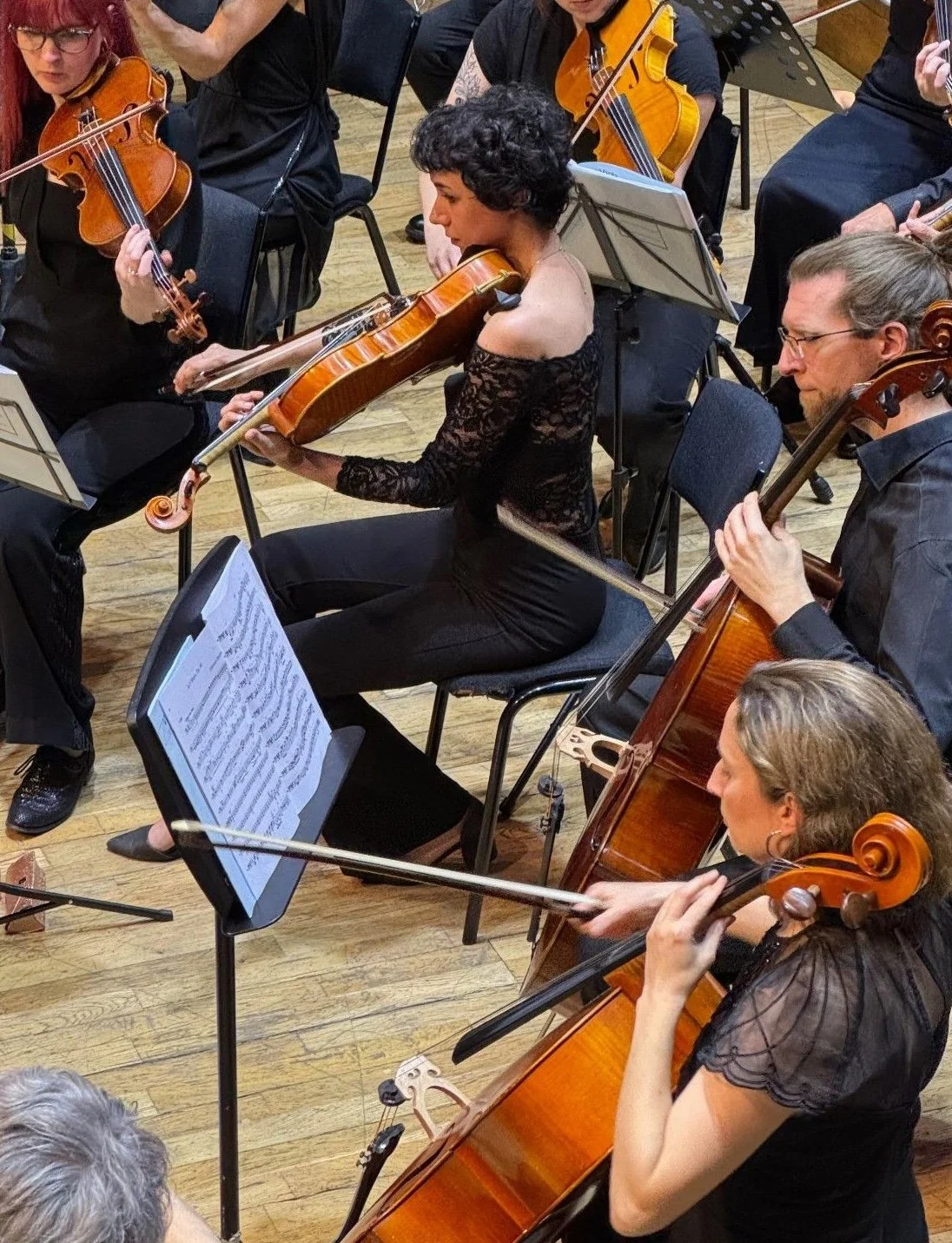
By Kate DowlerMusic is one of the great loves of my life. I started learning the piano at age 5 followed by ‘cello at age 8 and have continued to play through my adult life. These days, I play ‘cello several times a week in an orchestra and also in small chamber groups with other musicians: trios, quartets, quintets, sextets, octets, nonets, the combinations are endless!
Playing music, particular with other musicians is deeply absorbing. During those hours I am in a deep flow state, thinking about nothing but the music and the connection I am making with others through playing together. In a live performance, the experience is so absorbing that when it ends, it’s like coming to the surface after having been submerged in a deep ocean, or waking from an intense dream.
In the field of science of creativity, achieving a state of ‘flow’ is well known to enhance creative problem solving. Flow theory, developed by Mihaly Csikszentmihalyi (1), describes a mental state of complete absorption in an activity, characterised by deep focus, enjoyment, and a loss of self-consciousness, achieved when a challenging task perfectly matches one's skills.
The intensity of the flow state I experience when playing has got be thinking - could music as a creative act help us with unrelated creative problems we are looking to solve in other parts of our life? Could it enhance our creativity more generally?
The link between music and creative cognition
Looking into the scientific literature, I stumbled across an anecdotal, but powerful case study. Albert Einstein was an accomplished pianist and violinist who attributed many of his scientific breakthroughs, including the theory of relativity, to music.
"The theory of relativity occurred to me by intuition, and music is the driving force behind this intuition.” His son, Hans recounted that "Whenever he felt that he had come to the end of the road or into a difficult situation in his work, he would take refuge in music, and that would usually resolve all his difficulties" (2)
In recent years, a number of scientific studies have been conducted into the link between listening to music and creative cognition - the ability to come up with creative ideas and solutions. A 2017 study conducted by Ritter et al. (3) found that participants who listened to ‘happy music’ (music high on arousal and positive mood) whilst performing a divergent creativity task (testing the ability to generate a wide variety of ideas), performed better than those who performed the task in silence.
A different study by Alluri et al. (4) in 2012 used functional Magnetic Resonance Imaging (fMRI) to study how the brain processes different aspects of music, such as rhythm, tonality and timbre (sound ‘colour’ and quality). FMRI was used to record the brain responses of participants who were listening to a modern Argentinian tango. Most interestingly, the processing of timbre was associated with activations in the so-called Default Mode Network (DMF), which is assumed to be associated with mind-wandering and creativity.
Harnessing the creative power of music
How might we harness the creative power of music in our everyday lives and different work situations? Depending on how you work - solo or in groups, there are a number of simple ways that you can use music to enhance creativity.
In the INDUSTRY of Us studio, most of the team listen to music whilst working. I asked the team to share with me examples of the types of music they listen to. The most interesting finding was that the music chosen differed depended on the creative task at hand. For more convergent creative problem solving tasks which require focus, people tend to listen to minimalist, medium-pace instrumental music without lyrics:
“For focused, detailed work, I usually listen to minimalist classical music like Philip Glass. The repeating patterns and no lyrics help me stay focused” - Denisse
For more divergent, free-flowing tasks the team listen to more experimental music; often longer songs with unexpected changes in tempo, key and lyrics:
“I go for more experimental ‘jam band’ music where the songs are longer and take a variety of directions, tempos and weird lyrics. The less like a traditional song format (2 verses, chorus, bridge), the better. Weird lyrics can often take my brain on unexpected tangents, which can create unlikely ideas.” - Will
Whilst listening to music can be absorbing, playing music is even more powerful when it comes to solving difficult creative problems. So if you can play an instrument or sing, getting into a flow state as you become absorbed in the music can provide incubation time and stimulate your brain to solve unrelated creative problems you are working on in the background.
Music can also be a powerful tool when working in groups to solve creative problems. When running workshops and team sessions, it can help to set the scene for different activities, helping to establish the right mindset and mood for the task at hand. In these situations, music can act as a mood modulator, priming respondents to be in the right headspace for creative tasks.
Interestingly, this method of ‘mood modulation’ is also used in music therapy to help modulate patients’ emotional state. Research by Starcke et al. (2021) has shown that individuals who suffer from affective disorders benefit from listening to music according to the ‘iso principle’. The iso principle involves listening to music that matches the patient’s current mood, gradually shifting to music that represents a desired mood; as a result having a positive therapeutic effect (5).
In Summary
Creativity is one of the key competencies for the twenty-first century. It provides us with the capacity to deal with the opportunities and challenges that are part of our complex and fast-changing world. It’s important to understand how we can individually enhance our own creativity, and also how to amplify the creative power of the teams we work with.
Music provides an enjoyable and simple way of elevating creativity, providing a background context that is conducive to solving both divergent and convergent creative tasks. So, next time you put your headphones on, think about compiling your own creative playlist! Or, maybe now’s the time to learn that instrument you always wanted to play.
References
Csikszentmihalyi, M. (2008). Flow: The psychology of optimal experience. Harper Perennial.
Clark, Ronald W. (1971). Einstein. The Life and Times. New York: Crowell.
Ritter SM, Ferguson S (2017) Happy creativity: Listening to happy music facilitates divergent thinking. PLoS ONE 12(9): e0182210.
Vinoo Alluri, Petri Toiviainen, Iiro P. Jääskeläinen, Enrico Glerean, Mikko Sams, Elvira Brattico. Large-scale brain networks emerge from dynamic processing of musical timbre, key and rhythm. NeuroImage, 2011; DOI: 10.1016/j.neuroimage.2011.11.019
Starcke K, Mayr J, von Georgi R. Emotion Modulation through Music after Sadness Induction-The Iso Principle in a Controlled Experimental Study. Int J Environ Res Public Health. 2021 Nov 26;18(23):12486. doi: 10.3390/ijerph182312486. PMID: 34886210; PMCID: PMC8656869.